
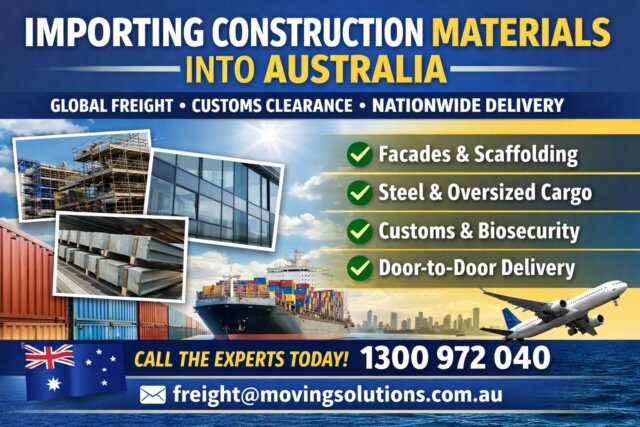
Importing construction materials into Australia allows builders and developers to access specialised global products while reducing procurement costs. However, the process requires careful planning, compliance knowledge, and professional freight coordination.
From facade systems to scaffolding equipment, understanding how international freight and customs work helps avoid costly delays.
Moving Solutions International assists businesses bringing building products into Australia from suppliers worldwide and delivering them across the country.
Many contractors choose overseas sourcing to:
Access specialised manufacturers
Reduce supply costs
Improve material quality
Secure engineered components
Increase project flexibility
As global trade becomes more accessible, construction material imports continue to grow across commercial and infrastructure developments.
Bringing building products into Australia covers a wide range of materials used in residential, commercial, and industrial projects.
Facade components often include curtain walls, aluminium composite panels, structural glazing, and large glass units. Because these products are fragile and high-value, they require secure packaging and coordinated shipping.
👉 Importing Facade Systems: Logistics & Compliance Guide
Companies that import scaffolding equipment must meet Australian safety and compliance standards. Steel frames, modular systems, and fittings must be properly classified for customs clearance.
Correct documentation reduces the risk of border inspections and delays.
👉 How to Import Scaffolding Equipment Without Delays
Large developments frequently involve heavy or oversized cargo such as:
Steel beams
Prefabricated structures
Formwork systems
Engineered components
These shipments may require breakbulk services or full container load transport depending on volume.
👉 Freight Forwarding for Oversized Construction Cargo
Understanding the steps involved in importing construction materials helps reduce compliance risks and protect project timelines.
Before shipping goods to Australia, confirm:
Commercial invoices
Packing lists
Certificates of origin
Product compliance documentation
Agreed Incoterms
For official requirements, refer to the Australian Border Force:
https://www.abf.gov.au
Accurate HS code classification ensures correct duty calculations and prevents unnecessary inspections.
Incorrect classification can result in:
Overpayment of duties
Delayed clearance
Penalties
Tariff guidance is available via:
https://www.abf.gov.au/importing-exporting-and-manufacturing/tariff-classification
Shipping options may include:
Full Container Load (FCL)
Less than Container Load (LCL)
Breakbulk freight
Air freight for urgent cargo
Sea freight remains the most cost-effective method for large volumes of construction products.
Australia maintains strict biosecurity regulations. Timber pallets and packaging must comply with ISPM 15 standards to prevent quarantine holds.
Proper preparation significantly reduces border inspection risks.
Even experienced project managers face challenges during international shipments.
Common causes include missing documents, incorrect tariff codes, or unpaid duties. Therefore, accurate paperwork is essential.
At times, major Australian ports experience congestion. As a result, delivery schedules should include buffer time.
Glass panels and metal components must be properly secured to prevent damage during shipping.
Working with experienced freight specialists reduces these risks and improves reliability.
Moving Solutions International coordinates importing construction materials from global suppliers to sites across Australia.
Our services include:
International freight forwarding
Customs brokerage
Duty optimisation
Biosecurity compliance coordination
Oversized cargo management
Australia-wide delivery
Because construction timelines are strict, we ensure materials move efficiently from origin to final destination.
If you are planning on importing construction materials for your next project, our team is ready to assist.
📞 Call 1300 972 040
📧 Email freight@movingsolutions.com.au
We manage global sourcing logistics and nationwide delivery across Australia.
Importing construction materials offers cost efficiency and access to specialised international products. However, customs compliance, freight coordination, and regulatory requirements must be handled correctly.
With professional logistics support, your construction imports become predictable and efficient.
Contact Moving Solutions International today to streamline your next shipment.